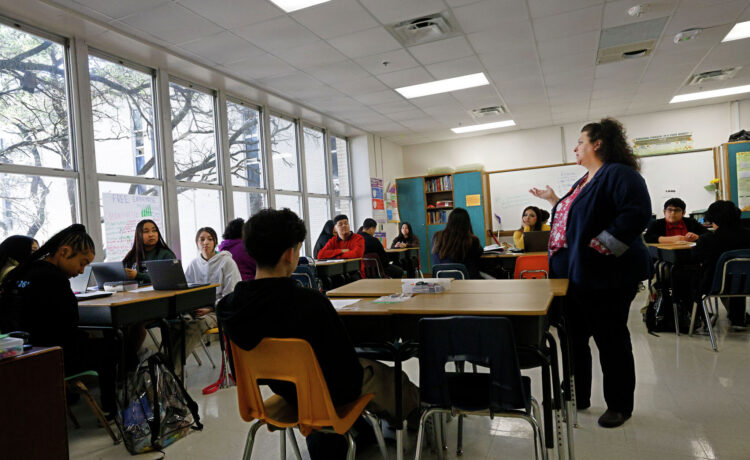

Julie Harris teaches a personal financial literacy and economics class at Skyline High School in March in Dallas.
The Class of 2030 will be required to learn how to budget, save, invest, and more.

A personal financial literacy class aims to help students make sound financial decisions. While Texas had been incorporating personal finance topics into its economics curriculum, supporters say having a standalone course allows for a deeper understanding.
Article continues below this ad
A 2025 law mandates students take a one-semester course, starting with this fall’s freshman class. The State Board of Education approved the learning standards in September in an 8-4 vote.
Here’s what you need to know about the requirement.
What is a personal financial literacy course?
HB 27, which passed with bipartisan support in 2025, directed the State Board of Education to develop learning standards for a personal financial literacy course.
The class will guide students in applying economic concepts to their own lives. For example, they will learn about credit and debit, budgeting practices, taxes, investment, and more, according to the learning standards. They will develop financial goals aligned with their career and personal aspirations. Students will also compare free enterprise to socialist and communist regimes.
Article continues below this ad
Related: Texas approves social studies rewrite, despite criticisms over portrayal of religion and race
“We’re trying to give kids some cautionary things to avoid but equip them with the tools they need to be successful,” said Aaron Kinsey, R-Midland, during the meeting.
How did the law change personal financial literacy education?
Before the law, Texas high school students had to earn at least three credits of social studies. For the required semester-long economics course, they could choose between “Economics with Emphasis on the Free Enterprise System and Its Benefits” and “Personal Financial Literacy and Economics.”
Both contained aspects of personal finance — to different degrees. In the first course, students received about 11 hours of personal finance instruction, according to Champlain College’s Center for Financial Literacy. The other class spent about 45 hours.
Article continues below this ad
When the new law passed, personal finance became a mandatory standalone class, and economics transitioned into an optional course. An Advanced Placement class that substantially aligns with the material can also fulfill the requirement.
What did state education leaders discuss?
During public comment, Ray Hughel, director of educational programs at SMU’s Bridwell Institute for Economic Freedom, expressed concerns that the learning standards focused too much on personal finance at the expense of economic concepts.
The curriculum doesn’t devote enough attention — or leaves out — foundational ideas, including incentives, trade, supply and demand, and competition, he said.
Article continues below this ad
“It’s crucial that we have students [who] are well-informed about financial matters and about economic matters, not just good at balancing their checkbooks, so to speak,” he said.
Leading up to the vote, Kinsey filed a new draft that he said took Hughel’s feedback into account. While his version pared down the curriculum, other members remained concerned that teachers wouldn’t be able to cover everything within the timeframe.
“It’s an unreasonable goal to reach,” said Evelyn Brooks, R-Frisco. “I don’t understand how teachers are going to teach this in a semester. We have to keep in mind this is all Texas students.”
Kinsey’s version ultimately passed. The curriculum goes into effect during the 2028-29 school year.
Why is there a push for personal financial literacy?
Many Americans lack an understanding of basic financial concepts, such as how insurance works, types of investment and how to manage debt. Over the past decade, American adults answered only half the questions correctly in an annual measure of financial literacy by Stanford University and TIAA Institute. In 2026, Gen Z answered 38% of the questions correctly, the report notes.
Article continues below this ad
Those who understand money manage it better, experts say. Knowing basic financial skills is associated with saving regularly, dealing with debt better and having a higher confidence in retirement.
Financial skills were once taught at home, but nowadays, parents may be ill-equipped to teach it, Annamaria Lusardi, senior fellow at the Stanford Institute for Economic Policy Research, previously told The Dallas Morning News.
“[It’s] much more complex with much more individual responsibility,” she said. “Schools should adapt in the same way we have added foreign languages, we have added computers.”
The DMN Education Lab deepens the coverage and conversation about urgent education issues critical to the future of North Texas.
Article continues below this ad
The DMN Education Lab is a community-funded journalism initiative, with support from Bobby and Lottye Lyle, Communities Foundation of Texas, The Dallas Foundation, Dallas Regional Chamber, Deedie Rose, Garrett and Cecilia Boone, Judy and Jim Gibbs, The Meadows Foundation, The Murrell Foundation, Ron Steinhart, Solutions Journalism Network, Southern Methodist University, Sydney Smith Hicks, and the University of Texas at Dallas. The Dallas Morning News retains full editorial control of the Education Lab’s journalism.