Goldman CEO Solomon says Treasury yields aren’t ‘a calamity’
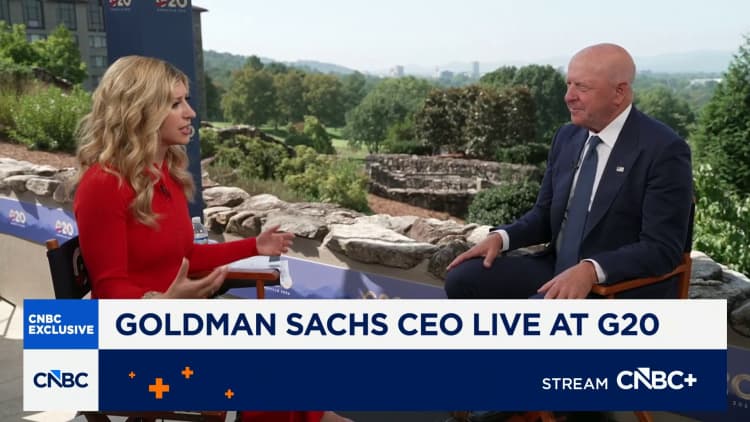
Currently elevated Treasury yields are not out of the ordinary considering fundamentals, Goldman Sachs CEO David Solomon told CNBC.
Speaking to CNBC on the sidelines of the G20 meeting, the bank executive said he isn’t concerned with the state of the U.S. debt market, in which yields recently hit their highest levels in nearly 20 years before easing.
“If you have any kind of a historical context, Treasury premiums can be higher, and it’s not a calamity,” he told Sara Eisen. “It’s really about what kind of growth can we drive in the economy, and what [are] our fiscal policy decisions going to be on a go-forward basis? And those are things that I think we’re going to have to wrestle with a lot.”
— Jeff Cox
How can the U.S. grow its way out of debt?
A sign displays national debt on a bus stop in Foggy Bottom on Aug. 20, 2026 in Washington, DC.
Anna Moneymaker | Getty Images
Bessent has repeatedly said the U.S. can grow its way out of the record debt pile it’s facing. The question: How can it amass the tens of trillions of dollars needed to do so?
The Trump administration has pushed tariffs on global trading partners as a way to narrow the U.S. budget deficit. But the Supreme Court struck down many of Trump’s steepest levies earlier this year, resulting in refunds for many consumer-facing companies.
The White House has continued doling out tariffs despite the ruling. Most recently, the U.S. slapped 50% import taxes on many Canadian goods.
Trump’s administration has also worked toward increasing tax refunds and loosening regulation on businesses to stimulate economic growth.
To be sure, not everyone is confident that the U.S. can climb its way out. Billionaire investor Ray Dalio said earlier this month that the U.S. could face a debt crisis in the coming years.
— Alex Harring
Eli Lilly CEO says GLP-1s likely haven’t ‘fully rippled through the economy’ yet
Eli Lilly CEO Dave Ricks said the economic impact of GLP-1 drugs likely hasn’t yet been fully realized, arguing that there are many more patients the treatments can capture.
“So far, there’s so few people as a percent of the total [population] on the drugs, believe it or not, that it hasn’t really probably fully rippled through the economy the way the way it could in the future,” Ricks told CNBC’s Sara Eisen. “It’s our job to make that true.”
He said there are an estimated 25 million to 30 million people globally on those obesity and diabetes drugs, but there are “more than a billion” potential customers. Lilly has “a lot more work to do to grow the market” and reach new patients, he added.
Speaking about the broader implications of the medicines, Ricks said GLP-1s could help improve individual health outcomes and potentially slow the growth of healthcare spending by reducing obesity-related diseases. He added that widespread adoption could create economic winners and losers, with industries tied to unhealthy food and alcohol consumption potentially facing pressure, while sectors focused on exercise and healthy lifestyles could benefit.
In response to recent reports of PepsiCo ending its employer-sponsored coverage of the drugs, raising concerns about the cost, Ricks said the number of companies that cover the medications is about “neutral.”
— Annika Kim Constantino
Bessent meets with Russia’s finance chief, talks Trump peace plan: Treasury
Treasury Secretary Scott Bessent and Russian Finance Minister Anton Siluanov at the G20 Finance Ministers Meeting in Asheville, N.C. on Aug. 31, 2026.
Courtesy: U.S. Treasury Department
Bessent discussed Trump’s “peace plan” with Russian Finance Minister Anton Siluanov in Asheville, the Treasury Department said.
— Kevin Breuninger and Megan Cassella
Eli Lilly has pursued more deals this year than all of last year, CEO says

Eli Lilly CEO Dave Ricks told CNBC the company has pursued more deals so far this year than all of last year, as it leverages a massive financial windfall from its blockbuster obesity and diabetes drugs.
Lilly on Monday said it would acquire privately held Merida Biosciences for up to $2.88 billion in cash, strengthening its immunology portfolio with an experimental treatment for thyroid-related autoimmune conditions. The pharmaceutical giant is investing in other disease areas to expand and diversify its drug pipeline beyond obesity and diabetes.
“We have been very active,” Ricks told CNBC’s Sara Eisen. “The company’s doing well. We’re generating a lot of cash flow. We’d rather invest that in our future and in future medicines for patients, and so this deal with Merida is just one more of those.”
— Annika Kim Constantino
Bessent claims rising U.S. bond yields are ‘flat’ under Trump
US Secretary of Treasury Scott Bessent speaks to reporters as he arrives for the G20 Finance Ministers and Central Bank Governors’ meeting in Asheville, North Carolina, on August 31, 2026.
Allison Joyce | Afp | Getty Images
Bessent insisted that Treasury yields have been “flat” since Trump took office last year. Yields, though, have moved somewhat higher amid pressure from tariffs and persistent inflation.
“The 10-year yield is flat since President Trump came in,” Bessent told CNBC’s Sara Eisen during an interview on the sidelines of the G20 meeting. Noting that Fitch Ratings had affirmed its “AA+” grade on U.S. debt, he added, “If there were a problem in the U.S. bond market, Sara, then people would be selling U.S. bonds and buying other countries’ bonds. But we are the best-performing market.”
Yields on U.S. government debt, which recently passed $40 trillion, have been volatile, however.
The benchmark 10-year yield has risen about 15 basis points since Trump took office in January 2025. Likewise, the 30-year yield is up some 40 basis points during the same period. Both were also higher in Monday trading.
While the moves are not dramatic, the elevated nature of yields has added to the debt burden, putting interest paid as the largest federal expenditure outside Social Security and Medicare.
On the Fitch affirmation, the firm also noted that “high fiscal deficits, a substantial interest burden, and high and rising government debt levels constrain the rating” and cautioned that the White House and Congress have “not taken meaningful actions” on the debt and deficit problem.
— Jeff Cox
Bessent shares G20’s biggest growth obstacles
US Secretary of Treasury Scott Bessent speaks to reporters as he arrives for the G20 Finance Ministers and Central Bank Governors’ meeting in Asheville, North Carolina, on August 31, 2026.
Allison Joyce | Afp | Getty Images
The G20 participants have “identified several impediments” to economic growth, Bessent said at the start of a growth-focused breakout session.
The obstacles include “excessive regulatory and administrative burdens, poorly designed financial incentives and tax systems, insufficient public and private investment, internal market fragmentation and gaps in workforce skills and mobility,” he said.
The Cabinet secretary asserted that the U.S. under Trump is “setting the pace in addressing each of these policy failures.”
— Kevin Breuninger
Solomon: I don’t see risks in credit system
Goldman Sachs CEO David Solomon speaking with CNBC from the G20 Finance Ministers Meeting in Asheville, N.C. on Aug. 31st, 2026.
CNBC
Goldman Sachs CEO David Solomon said he doesn’t see “a lot of risks” in the borrowing and credit system at the moment.
“We’re watching it closely, and I’m not overly concerned at the moment,” he told CNBC’s “Squawk on the Street” from Asheville.
He added that he’s seeing an “extraordinary” productivity boom but that it’s “not a straight line,” especially with disruptions from the Middle East.
– Laya Neelakandan
Bessent renews attack on Warren over yen letter
Treasury Secretary Scott Bessent, left, and Sen. Elizabeth Warren, D-Mass.
Getty Images
Bessent renewed his criticism of Sen. Elizabeth Warren Monday over what he called an error in her letter questioning the U.S. intervention to support the Japanese yen.
“What she hasn’t responded to” is the mistake Bessent identified in the letter, he said, noting that Warren serves on the Senate Finance Committee.
Warren’s Aug. 13 letter incorrectly suggested in its opening paragraph that Japan could owe money to the U.S. Treasury. The letter later correctly described the intervention as Treasury selling euros and buying yen and noted that Japan had not borrowed from the U.S.
Bessent’s written response last week did not disclose how much yen Treasury purchased, the execution rate or the position’s current value.
— Luke Fountain
U.S. CEOs attend G20 finance ministers for first time
JP Morgan CEO Jamie Dimon and Treasury Secretary Scott Bessent arriving at a G20 reception on Aug. 30th, 2026.
As finance ministers gather in Asheville, U.S. business leaders are among the invited guests.
Inclusion of CEOs in the G20 finance ministers meeting marks a first, according to a senior Treasury official, who said the administration is using its G20 presidency to promote engagement with the private sector.
Executives in attendance include Goldman Sachs CEO David Solomon, JPMorgan CEO Jamie Dimon, incoming Truist Bank CEO Mike Lyons, Eli Lilly CEO David Ricks, Deere & Co. CEO John May, Medtronic CEO Geoff Martha, and 3M CEO Bill Brown.
— Mary Catherine Wellons
Bessent: Sanctions pressure on Iran can work without Chinese help
Bessent insisted to CNBC that the U.S. plan to choke Iran’s economy by slapping sanctions on its financial enablers can work even if China, Tehran’s top trade partner and oil buyer, doesn’t play ball.
“I would push back on that false narrative that somehow the media has jumped on this, ‘Oh, you can’t do it without China,'” he told CNBC’s Sara Eisen.
“Well, you can,” he said, “because one of the things is there’s only the 30 million of Iranian barrels of Iranian oil left on the water because of the blockade. So even if they were to get remittances from China, that’s going to run out.”
China has publicly said it opposes “illicit unilateral sanctions that have no basis in international law.” Bessent suggested to CNBC that Beijing may be less resistant behind the scenes.
“We have more in common with the Chinese on Iran than we disagree on,” he added. “The Chinese agree that Iran cannot have a nuclear weapon. The Chinese agree that the [Strait of Hormuz] must be open to free and fair ship transit.”
Bessent also said he met with Chinese central bank Governor Pan Gongsheng on Sunday, but offered few details about their conversation.
— Kevin Breuninger
Bessent to push global counterparts on Iran
Bessent is expected to ask his counterparts in virtually every G20 meeting if their countries will join the U.S. in its goal of cutting off Iran from the global economy, Treasury officials have said.
In an interview with CNBC’s Sara Eisen Monday morning, Bessent said he spoke with Chinese central bank Governor Pan Gongsheng on Sunday, and confirmed that he will be meeting with his Canadian counterpart in Asheville.
Bessent previously told the Associated Press that he would speak to his Chinese counterparts at the meeting, and that “all options are on the table” to respond to Beijing’s continued purchases of Iranian oil.
He also told the AP that the Trump administration plans to unveil sanctions on another bank this week as part of its plan to economically isolate Iran by targeting its financial “enablers.”
Bessent is also likely to sit down with officials from South Korea and Argentina, among other nations.
— Kevin Breuninger and Megan Cassella
Fed Chairman Warsh touts ‘global investment surge’
(L-R) US Secretary of Treasury Scott Bessent and US Federal Reserve chairman Kevin Warsh are seen on a TV screen as they speak during the G20 Finance Ministers and Central Bank Governors’ meeting in Asheville, North Carolina, on August 31, 2026.
Allison Joyce | Afp | Getty Images
Federal Reserve Chair Kevin Warsh expressed confidence in the U.S. economy during brief remarks Monday morning at the G20 conference.
“As I show up today, 100 days into my tenure, a comment that I made in Jackson Hole a day or two ago is that secular stagnation seems like a description of a past long ago. The new period is one of secular growth,” Warsh said, referring to his Friday presentation at the Fed’s annual symposium in Wyoming.
The central bank leader added that the current climate is “one of a global investment surge,” echoing a theme he has sounded repeatedly over the past several months of artificial intelligence spurring cash flows towards business growth.
— Jeff Cox
Bessent: Only way past debt mess ‘is to grow our way out’
An electronic display shows the national debt in Washington, Aug. 19, 2026.
Mandel Ngan | AFP | Getty Images
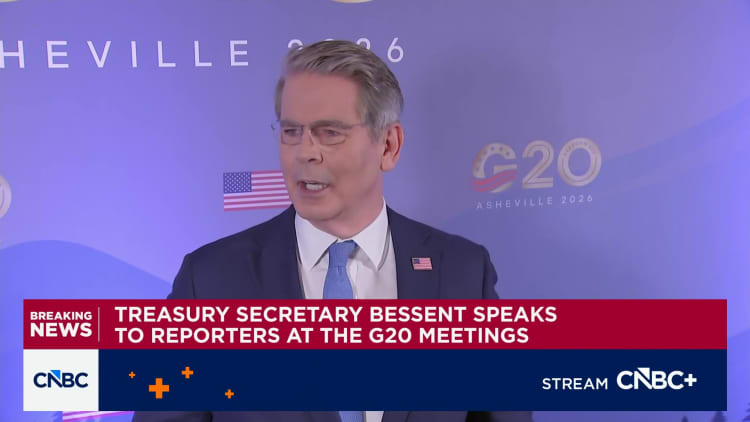
Treasury Secretary Scott Bessent touted U.S. economic strength, insisting it’s possible to grow out of the escalating debt burden the nation faces.
“Our goal here today is to reiterate that our message of growth. The world is awash in debt post [global financial crisis], post Covid, and the only way for us to get out of this is to grow our way out of this,” Bessent told reporters on the opening day of the G20 summit. “I’m confident that a lot of the leaders are very receptive to this.”
The government faces a $40 trillion debt load and the likelihood of a $2 trillion deficit for fiscal 2026.
Conscious of those challenges, Bessent said “we are left with a mess” from the Biden administration.
“I say sometimes that I feel like an emergency room doctor, and the economy is the patient, and the American people were backed over by the Biden Mack truck,” he said. “We have stabilized the patient, and now we’re in the healing portion, and real incomes are increasing.”
— Jeff Cox
Bessent: Iran’s economy could collapse ‘within weeks or months’
A woman walks past a wall mural of Iran’s slain supreme leader Ayatollah Ali Khamenei, along a street in downtown of Tehran on August 31, 2026.
Atta Kenare | Afp | Getty Images
Iran’s economy could collapse in as soon as a few weeks, Bessent predicted, while insisting that isn’t a prerequisite for a breakthrough with Tehran.
“We have the blockade, and we are going to continue exerting pressure, and we’ve had very good discussions here already,” Bessent said at a press gaggle when asked how long it could take for Iran’s economy to buckle.
“I think it could be within weeks or months,” he said, but added, “The economy doesn’t have to collapse … we just have to have the regime come to their senses.”
— Kevin Breuninger
Bessent thanks EU for supporting ‘Operation Economic Outcast,’ the new anti-Iran sanctions plan
31 August 2026, United States, Asheville: Conference participants are seated during the first working session at the meeting of finance ministers and central bank governors from the G20 countries.
Bernd von Jutrczenka | Picture Alliance | Getty Images
Bessent thanked the European Union “for their very fulsome, fulsome support for Operation Economic Outcast” as he arrived at the G20 meeting.
“They made it known today in the strongest terms that they supported” the plan, which aims to strangle Iran’s economy by targeting its international “enablers” with secondary sanctions, Bessent said.
The European Commission, the executive body of the EU, said in a statement overnight that it “welcomes efforts at ensuring that Iran ceases its destabilising activities and engages in peace negotiations with good faith.”
The commission said it supports efforts to achieve that goal “through additional economic pressure, including through the US led Operation Economic Outcast.”
“The EU will continue to work closely with the United States and other G7 and international partners to maintain pressure on Iran and contribute to de-escalation and regional stability,” the statement said.
— Kevin Breuninger
Bessent: Iran is taking sanctions ‘very seriously’
31 August 2026, United States, Asheville: Scott Bessent (M), U.S. Secretary of the Treasury, opens the first working session at the meeting of finance ministers and central bank governors from the G20 countries.
Picture Alliance | Picture Alliance | Getty Images
Iran is taking the threat of strengthened U.S. sanctions “very seriously,” Bessent said.
Recent rhetorical and military aggression from Iran’s leaders shows “they’re in shock at the state of their economy,” the Treasury secretary told reporters before heading into G20 meetings.
“I would think that they are lashing out kinetically because they are losing economically,” he said.
— Kevin Breuninger
Some reporters were barred from the Asheville meetings
31 August 2026, United States, Asheville: Scott Bessent, U.S. Secretary of the Treasury, speaks ahead of the start of the meeting of finance ministers and central bank governors from the G20 nations.
Bernd von Jutrczenka | Picture Alliance | Getty Images
The Treasury Department blocked some reporters from The New York Times, The Wall Street Journal and Bloomberg from attending the meetings in Asheville, barring access from three of the nation’s largest and most influential newsrooms.
Treasury’s refusal to give the reporters credentials is the latest instance of the Trump administration interfering with press access. Last year, the Pentagon imposed a strict new press policy that saw nearly all news organizations leave the building rather than sign an agreement to abide by the policy seeking to limit what news organizations could publish. Some of the media outlets excluded from the G20 said the move is intended to evade public scrutiny.
Nearly 300 members of the media, including one Times reporter, will have high-level access to policymakers throughout the event, a Treasury spokesperson said in a statement.
“News coverage should be focused on informing and educating the American people, rather than prioritizing clicks, engagement, or sensationalism,” the spokesperson said.
— Garrett Downs
Warsh on hand at G20 following Jackson Hole speech
Kevin Warsh, chairman of the US Federal Reserve, left, Andrew Bailey, governor of the Bank of England, center, and Tiff Macklem, governor of the Bank of Canada at the Jackson Hole Economic Symposium in Moran, Wyoming, on Aug. 28, 2026.
David A. Grogan | CNBC
Federal Reserve Chair Kevin Warsh will be appearing in Asheville, fresh off this speech last week at the central bank’s Jackson Hole, Wyoming, symposium.
The Fed leader is expected to deliver welcoming remarks for several sessions, with no indication that he will comment on policy.
During last week’s speech, Warsh hinted higher interest rates could be necessary absent further progress on getting inflation back to the Fed’s 2% target.
— Jeff Cox