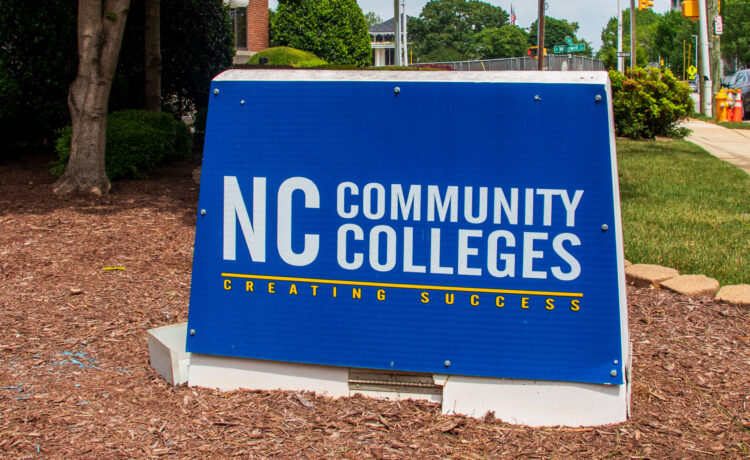
When the North Carolina General Assembly enacted a new state budget earlier this summer, the state’s community colleges received a substantial boost in taxpayer funding. In addition to putting $99 million toward enrollment growth, lawmakers increased the system’s annual funding by $57.5 million to finance its Propel NC program, which more closely aligns degrees and certificates to the job skills, disciplines, and professions in highest demand across our state’s urban, suburban, and rural areas.
The system office praised the new state budget for making a “historic investment” in North Carolina’s community colleges, with “new money aimed squarely at the workforce development that fuels the state’s economy.” That’s a fair description, I think, particularly when placed within the broader context of higher education funding in our state.
North Carolina has long been one of the most generous funders of public universities in the country — as well as one of its stingiest funders of two-year institutions.
According to FY 2025 data from the State Higher Education Executive Officers Association (SHEEO), state and local governments appropriated an average of $7,836 per full-time-equivalent student to North Carolina’s community colleges, lower than in all but nine other states. At the same time, appropriations to the University of North Carolina System averaged $19,393 per FTE student. Only Wyoming ($31,215), Illinois ($29,345), Alaska ($22,748), and Hawaii ($19,758) spent more — and, frankly, only Illinois has a truly comparable system given that the other three states have small populations and atypical geographies.
Until this year, the funding trajectories of the two systems were also divergent. From 2019 to 2025, appropriations per student in North Carolina’s community colleges declined by a fifth after adjusting for inflation. During the same period, UNC appropriations rose by 7% in real terms. These figures were, admittedly warped by federal COVID-era stimulus and subsequent inflation spikes. But the divergence remains noteworthy.
In no way do I mean to suggest that two-year and four-year institutions ought to receive equivalent funding. The latter are obviously more expensive to operate, and include medical care and research functions that two-year institutions typically do not. Interestingly, while the ratio of university-to-community-college funding is higher in our state than in any other besides Florida, quite a few states do, in fact, pursue more of a funding parity between the two categories or even subsidize two-year institutions more generously than they do four-year institutions. The most-common explanation is that the public university systems in these states charge far higher tuition and fees than North Carolina. They still spend vastly more dollars on their four-year institutions than on their two-year ones, though the money comes from sources other than government appropriations. I don’t favor our state going down that road.
Nor do I mean to suggest that North Carolina’s community colleges are subpar and the UNC System is peerless. Resources are essential but no guarantee of success. Some of the best community colleges in our region, if not our nation, can be found right here in the Tar Heel State. And while many UNC campuses have become more cost-effective over the past decade, there remains plenty of room for improvement. That’s one reason I’m no advocate of large-scale increases in tuition across the UNC System.
To be clear, the General Assembly didn’t boost community-college funding in 2026 to meet some national statistical standard. They did so because they saw great promise in the Propel NC initiative, which will allocate more funds to higher-demand fields such as advanced manufacturing, public safety and allied health and then regularly reevaluate funding levels based on job and salary data.
Economic conditions are never static. Even so, today’s economy strikes many as especially prone to dynamic change, given the vagaries of international markets, the Trump administration’s mercurial policies on import taxes, and the effects — both creative and disruptive — of artificial intelligence. In such an environment, a strong network of community colleges with committed instructors, flexible offerings, and nimble leaders will likely prove to be a tremendous asset.
John Hood is a John Locke Foundation board member. His books Mountain Folk, Forest Folk, and Water Folk combine epic fantasy and American history.