The Springdale-based private school that received the most Arkansas taxpayer funds in the 2025-26 school year raised its price of attendance by an average of 24% in the three years since the state’s universal school choice program began.
Annual tuition and base fees for a student entering fourth grade at Shiloh Christian School were $10,195 in fall 2023, the first year of the state’s Educational Freedom Account program. In fall 2026, as the school choice program enters its fourth school year, tuition and fees are $12,305. Members of Cross Church in Springdale pay slightly less and prices vary according to grade level.
Shiloh Christian School was not alone in raising prices. Little Rock Christian Academy, the second-largest recipient of Educational Freedom Account funds last year, raised tuition and fees by about 14% over the same three-year period. A fourth grader could attend Little Rock Christian for $13,195 annually in fall 2023, while now the school charges $14,958.
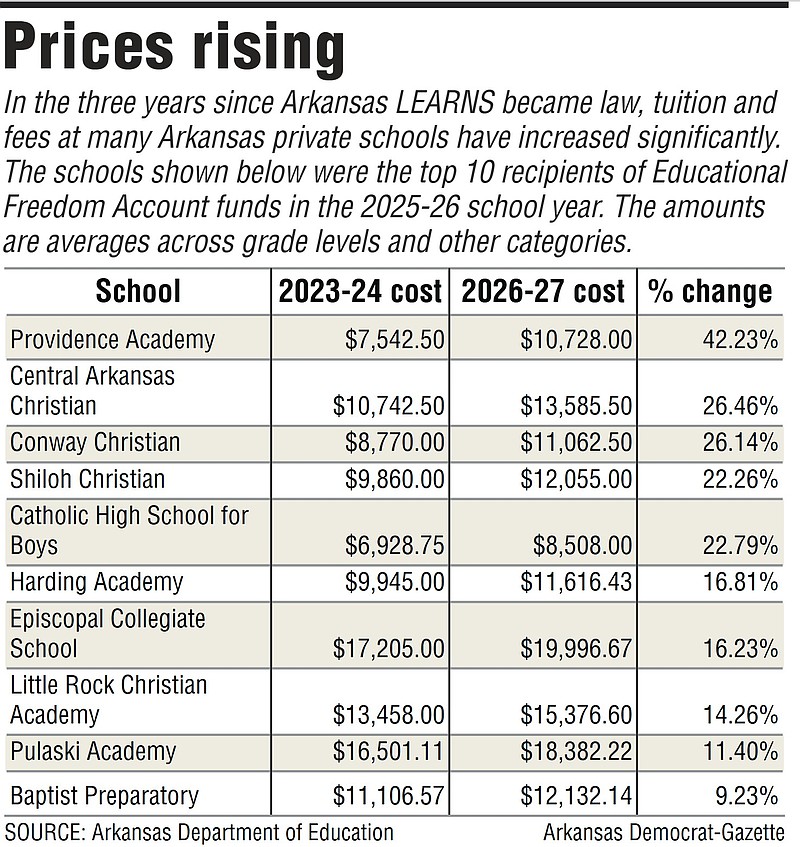
The top 10 private schools ranked by state funding raised their tuition and fees between 11% and 42% from fall 2023 to fall 2026, records from the Arkansas Department of Education show. The Arkansas Democrat-Gazette calculated the percentage changes — averaged across grade levels and other categories — based on documents the schools provided to the Education Department and information on the schools’ websites.
The price hikes have far outpaced the state’s increases to the size of an individual Educational Freedom Account over the same time period, putting access to some schools farther out of reach for low-income families.
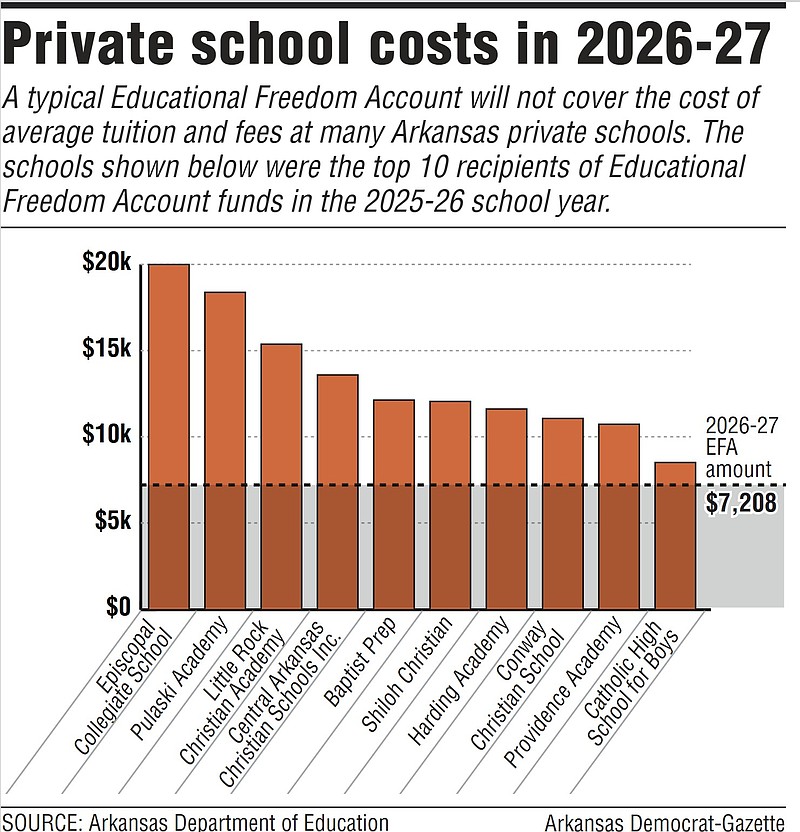
In the 2023-24 school year, most families with Educational Freedom Accounts received $6,672 per student. For the 2026-27 school year, most families will get $7,208 per student, about 8% more than when the program began. Some students with disabilities get somewhat larger awards.
Tuition at each of the top 10 private schools exceeds what a student receives in Educational Freedom Account funds this year. The gap was smallest for Catholic High School for Boys in Little Rock, which charges between about $8,000 and $9,000 this year. That is still roughly $800 to $1800 beyond what most Educational Freedom Account participants received, though Steve Straessle, its head of school, said Catholic High has “never turned away a student because of inability to pay.” Straessle is a columnist for the Arkansas Democrat-Gazette.
The gap was largest for another Little Rock school, Episcopal Collegiate. The price of attendance this year is between $17,600 and $21,610, or nearly three times more than what most Educational Freedom Account students will get.
“Episcopal Collegiate School considers a number of factors when setting tuition each year, foremost among them the projected cost of delivering the School’s educational program,” Lauren Curtis, an Episcopal Collegiate spokeswoman, said in an email. “Like businesses and households, independent schools are affected by inflation and the rising costs of goods and services.”
Shiloh Christian School and Little Rock Christian Academy did not return requests for comment about price increases.
Gov. Sarah Huckabee Sanders and other school choice advocates have said the Educational Freedom Account program is critical to ensuring families have access to the education that best meets their children’s needs. The choice program was created by the LEARNS Act of 2023, which Sanders championed.
“The EFA program is clearly making education freedom more accessible to more students: the number of families using EFAs to attend the school of their choice has risen to roughly 50,000 this year, more than ever before,” Sam Dubke, spokesman for the governor’s office, said in an email. “(The Arkansas Department of Education) has commonsense controls in place to review tuition increases and ensure they are related to justified education expenses, such as teacher salary increases or to fill funding gaps previously covered by charitable donations.”
Kaelin Clay, a spokeswoman for the Education Department, said the department “reviews tuition and fee changes annually and may require schools to justify significant increases.”
The department has never denied a private school’s tuition or fee increase, Clay said. State officials have “reviewed increases at numerous schools to ensure appropriate justification is provided.”
The increasing gap between the cost of attending private schools and the amount of money provided by Educational Freedom Accounts is “wholly predictable,” said Bill Kopsky, director of the Arkansas Public Policy Panel and Arkansas Citizens First Congress.
Kopsky is a critic of the program and among the sponsors of a failed campaign to enact a state constitutional amendment that would have required private schools that accept state funds to follow the same regulations as public schools.
“We’re just seeing the exact same thing play out in Arkansas that’s happened in other states, with these vouchers becoming a story of the ‘haves and the have-nots,’ and making that disparity between the folks with resources and the folks without resources even wider than it was before,” Kopsky said. Educational Freedom Accounts are often informally called vouchers.
Emmy Henley, managing director of The Reform Alliance, a school choice advocacy group, said in an email that rising tuition “can affect whether a particular school remains affordable — especially for lower-income families.”
However, she added, “Even when tuition exceeds the EFA amount, reducing a family’s cost by several thousand dollars can turn an option that was previously out of reach into a realistic possibility. The EFA is intended to expand access, not guarantee that every participating school will be available to every family at no out-of-pocket cost.”
Many schools also offer sliding scales based on family income, or offer scholarships to cover some or all of the cost of attendance. At Catholic High School, for example, fundraising plays a key role in ensuring the school can provide full tuition support to students with demonstrated financial need, Straessle said.
Educational Freedom Accounts pay for private school tuition and some homeschool expenses. The 2025-26 school year was the third year of the program but the first in which every student in the state was eligible to participate. In its first two years, Educational Freedom Accounts were limited to certain groups and capped at a certain number of students.
During this spring’s fiscal legislative session, Arkansas lawmakers approved up to $379 million in taxpayer funds for the school choice program for the current school year, about 22.5% more than the $309.4 million approved for 2025-26.
Out of 166 private schools participating in the program last year, the top 10 received more than $61 million in state funds. Shiloh Christian topped the list, at about $10.6 million, followed by Little Rock Christian at about $10.4 million and Pulaski Academy at about $8 million. Episcopal received about $4.8 million and Catholic High received about $4 million..
Education Department data shows roughly 28,100 students used their accounts to attend private school in the 2025-26 school year. Roughly 18,500 received an account to be homeschooled or attend a microschool.
A state-commissioned report on the 2024-25 school year found that the vast majority of Educational Freedom Account holders were already enrolled in private schools or were being homeschooled before enrolling in the school choice program. The state hasn’t yet released similar numbers for the 2025-26 school year.
RISING COSTS
Costs differ widely from private school to private school. Many charge higher tuition and fees for upper grades, and the grades each school groups together at a single price point can vary. Schools that are religiously affiliated may offer discounts for members of their parent church.
Darrell Smith, the head of the state Education Department’s school choice office, explained at a Sept. 11, 2025, state Board of Education meeting that private schools participating in the school choice program must submit a “renewal packet” with updated information to the Education Department. That packet includes tuition rates.
“We’re looking longitudinally at their tuition, and we look at their tuition for the previous year to see if there’s a difference,” Smith told the board. “If we see something that’s a little high we start investigating. It’s not a no, but it allows us to ask some questions and spend some time with that particular school and analyze, ‘Why did you raise tuition?'”
The Education Department did not appear to receive written justifications from any of the top 10 schools regarding tuition and fee increases for the 2026-27 school year. A request for documents under the state Freedom of Information Act did not return records from those schools.
Episcopal Collegiate has raised average tuition and fees by about $2,791, or about 16%, since the Educational Freedom Account program began.
The school choice program “has never been a factor” when Episcopal sets its tuition, according to Curtis, the school’s spokeswoman. She said Episcopal’s tuition hike since 2023 was similar to the increase in the Consumer Price Index for All Urban Consumers, a measure of inflation, over a similar time period.
Catholic High School raised average tuition and fees by about $1,579, or about 23%, since the Educational Freedom Account program began.
The price hike takes into account cost of living increases and raises for teachers, according to Straessle. He pointed out that Catholic High charges less than many private schools.
“The reason the percentage (increase) is so high is because our tuition is so low,” Straessle said in an email.
Catholic High School “markets to the middle class,” offering tuition assistance to students from lower-income families, according to Straessle. He maintained that access is “intrinsic” to its Catholic identity.
“Without context, the percentage of increase looks high. However, with the actual numbers, it’s easy to see that Catholic High has been sincere in its mission to remain affordable,” Straessle said.
Among the top 10 schools, Providence Academy in Rogers raised its prices the most from 2023 to 2026, increasing its average cost of attendance by 42%. For students in grades K-6, tuition and fees increased from about $6,590 in the 2023-24 school year to $9,409 in the 2026-27 school year. For grades 7-12, tuition and fees increased from about $8,495 to $12,047.
Tuition and fees were also rising at Providence before the Educational Freedom Account program began, but not by nearly as much. In the four years prior to the program’s start, the school’s attendance costs rose by about 17%.
The school received just over $4 million in Educational Freedom Account funds in the 2026-27 school year, the ninth most in the state.
Of the top 10 schools, Baptist Preparatory in Little Rock saw the smallest percentage increase in attendance costs from 2023 to 2026, at about 11%.
JUSTIFICATIONS
Smith and other state officials did meet or email with leaders from at least 13 other private schools regarding proposed price increases over the summer, according to meeting summaries and emails obtained by the Democrat-Gazette.
Several themes recur among their responses. Many of the schools said their tuition increases were meant to boost pay for teachers to stay competitive with other schools. Others cited facilities expansions or improvements to accommodate more students.
First Academy, a Rogers-based private school that has participated in the Educational Freedom Account program since the program’s inception, submitted material to the Education Department reflecting a roughly 15% increase in tuition between the 2025-26 and 2026-27 school year, according to a summary of the meeting developed by the department.
The summary says the increase “exceeds the 10% threshold and required additional discussion to ensure the increase is reasonable and aligned with program safeguards.”
The cost to attend First Academy in the 2023-24 school year was $6,075. In 2026-27, it was $8,688, a roughly 43% increase over the past three years.
In a response to the Education Department, First Academy Principal Matt Brewer said the tuition hike was driven by plans to add a grade level to the school. The school needed to hire more instructional staff and administrators as a result, the summary states. Brewer also said the school was boosting salaries to “remain competitive in the Northwest Arkansas region and retain high-quality teachers.”
Clay, the Education Department spokeswoman, told the Democrat-Gazette the department doesn’t set a specific maximum threshold when evaluating a proposed increase.
“Schools were required to explain the factors driving the increase, provide information regarding the cost of educating a student, and explain how the additional revenue would support the educational program and opportunities available to students and families,” she wrote in an email. “ADE considers the totality of that information rather than relying on a single percentage.
Higher teacher compensation, operational costs and growing enrollment all drive increased tuition, Clay said.
The Education Department evaluates “whether the increase has a reasonable basis and is consistent with the educational services being provided,” she said “ADE’s role is not to manage an independent school’s operating budget line by line, but participation in the EFA program does carry an expectation of transparency and accountability because public funds are involved.”
Records show that administrators from Easterseals Academy in Little Rock, a school serving students with developmental disabilities, told Education Department officials in a June 26 meeting that the school’s enrollment doubled from 75 to 150 students in the 2025-26 school year. School officials expected enrollment to increase from 150 students to 190 in the 2026-27 school year.
The school maintains small class sizes and needed to hire additional educators. Easterseals Academy also told the Education Department the expansion increased operational costs.
Several schools, including First Academy, told the Education Department their parent church or organization wanted them to be more responsible for their own costs, such as utilities.
During the September 2025 state Board of Education meeting, Smith told board members, “A lot of time you’ll see these schools were heavily subsidized by an outside source, such as Catholic schools being subsidized by parishes.
“We want these schools to be able to live on their own, not reliant on outside sources,” Smith said.
NATIONAL INCREASES
About 20 states have large-scale education savings account or voucher programs similar to Arkansas’, including Arizona, Florida, Indiana, Iowa, Tennessee, Texas and West Virginia.
Such programs likely increase private school tuition in their states, according to a September 2025 report by the National Center for Research on Education Access and Choice. The report found that, between the 2021-22 and 2024-25 school years, private schools in states with education savings account programs tended to increase their attendance costs by 5-10%.
The study cautions that “the effects of universal school vouchers have been modest so far,” in part because “the lion’s share of universal voucher awards seem to go towards families with students already in private school, likely making the tax and subsidy system less progressive.”
However, the report contends universal school choice programs “promise to substantially reshape this education landscape over time, including shifts in enrollment from public to private schools.”
Such programs have helped to make private schools more affordable overall, according to the report. “Vouchers dramatically reduce the net price for most parents by 50-80 percent,” the report states.
The number of private schools in Arkansas has rapidly increased since the Educational Freedom Account program began. An article published in July by ProPublica says about 120 private schools have opened in the state in the three years since LEARNS was passed — the most out of any state with similar universal school choice programs, according to the news organization.
Henley, the Reform Alliance director, said Arkansas families should also remember that educational options beyond private and traditional public schools may be available in their area.
Those choices can include public school transfers, charter schools and microschools, she said.
When considering a school, Henley urged families to ask about the total cost of attendance, as well as whether they offer need-based assistance, sibling or church-member discounts, or payment plans. Families should ask what additional fees they may charge as well.
Henley also said families can participate in a federal tax credit scholarship program that begins Jan. 1, which could provide additional financial help on top of the state’s Educational Freedom Account program.
“No single program will make every school affordable for every family,” Henley said. “The larger goal of school choice is to create multiple pathways so that a family’s income or ZIP code does not determine whether a child can access an education that meets his or her individual needs.”
Asked whether rising tuition makes the Educational Freedom Account program less accessible for lower-income families, Clay said, “Affordability is an important consideration, and it is one reason (the Education Department) reviews significant tuition increases rather than simply accepting them without additional scrutiny.
“At the same time, an EFA is intended to expand a family’s educational options; it is not a guarantee that the award will cover the full cost of tuition at every participating private school,” she said.
Information for this article was contributed by Anne Li of the Arkansas Democrat-Gazette.
With support from the ADG Community Journalism Project, LEARNS reporter Josh Snyder covers the impact of the law on the K-12 education system across the state, and its effect on teachers, students, parents and communities. The Arkansas Democrat-Gazette maintains full editorial control over this article and all other coverage. View all LEARNS Act coverage at arkansasonline.com/learns.

Josh Snyder reports on how the state LEARNS Act has changed public education, including on the local level. His position is funded by the ADG Community Journalism Project. A Phoenix native and graduate of the Clinton School of Public Service, Josh has worked for the Arkansas Democrat-Gazette since 2018.