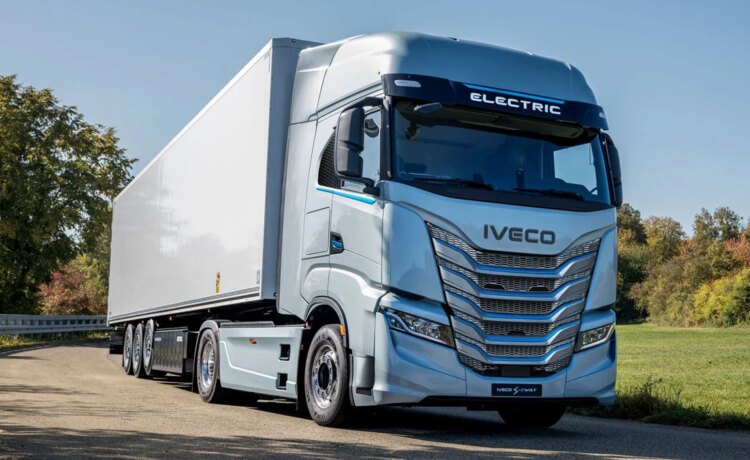
European truck manufacturers such as Daimler Truck, Traton, and Volvo could lose a quarter of the European market for electric trucks to competitors from China and the USA by 2030, warns a T&E analysis.
The T&E investigation is based on an evaluation of the costs, technical performance data, and stated goals of the new market participants. The result: The total cost of ownership (TCO) of a Chinese e-truck can be up to 12 percent lower compared to an equivalent European model. In an example calculation, the cost per kilometer drops from 0.63 to 0.55 euros. Over five years, this results in savings of around 43,000 euros. In an industry operating with profit margins of just 1.5 to 2 percent, such a difference can be a decisive factor in purchasing decisions.
Price difference of up to 95,000 euros per vehicle
The actual price difference is already considerable today. While European heavy-duty e-trucks cost an average of around 320,000 euros, Chinese manufacturers are targeting prices of approximately 225,000 to 250,000 euros, a discount of roughly 30 percent. For example, Sinotruk intends to offer its Global E700 in Europe for around 250,000 euros and has already begun assembly in Austria. The Chinese industrial and commercial vehicle group Sany has been delivering its electric 4×2 tractor unit e263 to Europe since spring 2026 and reports more than 30,000 e-tractors in use worldwide. Meanwhile, BYD is building an assembly plant in Hungary with a target capacity of 5,000 heavy-duty units per year. From the USA, Tesla could put additional pressure on the market with the Semi.
The cost advantage of the new competitors is due, among other things, to significantly cheaper battery cells. According to T&E data, European battery cells are currently around 90 percent more expensive than Chinese ones. Although this gap is expected to shrink to about 14 US dollars per kilowatt-hour by 2030, it remains a structural disadvantage. At the same time, T&E attests that Chinese e-trucks are at least on par with European models in terms of range, charging time, payload, and energy efficiency.
EU fleet limits as drivers and risks
A significant driver of electrification is the EU CO₂ fleet limits for trucks, which came into force in 2024, with the first reporting period starting in July 2025. In 2025, 5.6 percent of all newly registered trucks in the EU were already emission-free, double the number from the previous year. Germany, at 7.1 percent, is even at the forefront of the five largest European markets, an increase of over 60 percent compared to 2024. The revised EU regulation provides for emission reductions of 45 percent by 2030, 65 percent by 2035, and 90 percent by 2040. Manufacturers who miss their targets face penalties of up to 4,250 euros per gram of CO₂ per tonne-kilometer.
For Daimler Truck, Traton, and Volvo, this means enormous investment pressure. Daimler Truck aims to deliver more than half of its new vehicles in Europe locally emission-free by 2030 and has launched a cost-reduction program of over one billion euros. Traton wants to switch 50 percent of its EU sales to electric powertrains and is investing one billion euros in a joint battery platform for MAN and Scania. Volvo Trucks, currently the market leader in e-truck sales in Europe, is pursuing a goal of at least 35 percent battery-electric trucks by 2030.
T&E warns of a repeat of the passenger car scenario
Johanna Braun, Manager E-Mobility Trucks at T&E Germany, sees that the decisive moment has come: “Competitive e-trucks from China and the USA are already entering the European market, with more models announced.” Manufacturers should learn from the mistakes of the automotive industry. Delaying electrification “paves the way for competitors from the USA and China”, according to Braun.
T&E calls on the German government to advocate for ambitious CO₂ fleet limits in Brussels. At the same time, industry observers are discussing possible trade policy measures such as anti-dumping investigations against subsidized e-trucks from China. The EU faces a trade-off: affordable e-trucks would accelerate the decarbonization of transport but threaten industrial sovereignty. Whether European manufacturers will join the race in time is likely to be decided in the coming years. The EU truck market, with around 245,000 vehicles annually, is of central economic importance for Daimler Truck, Traton, Volvo, IVECO, and DAF.
More on battery-electric trucks
(fpi)