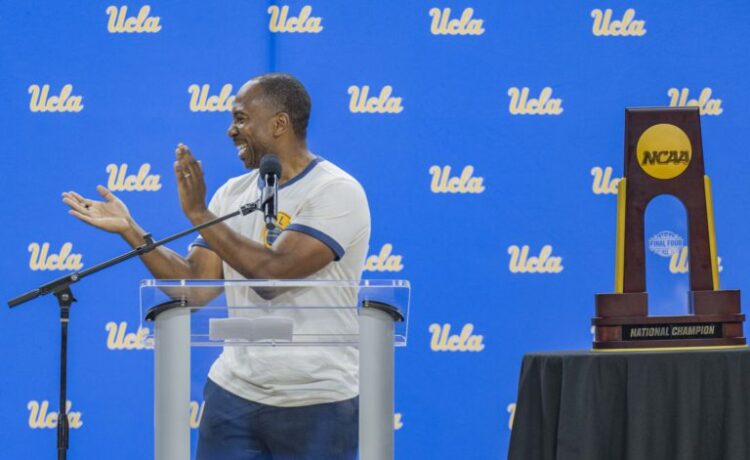
On Monday, I reported on what was probably the biggest piece of news in my journalism career.
When I randomly checked my phone and clicked on an X notification, my page slowly filled with reports that former UCLA athletic director Martin Jarmond was dismissed after six years, making my mind do a few skips.
I almost thought this was an online prank.
Alas, here we are.
Chancellor Julio Frenk announced in a campuswide email that he let go of Jarmond and would replace him with former Los Angeles Lakers executive Tim Harris, who will serve as both director and UCLA Athletics CEO on a pro bono basis, as a search for a permanent replacement will take place. Jarmond’s remaining $6.5 million is expected to be paid out.
[Related: UCLA athletics director Martin Jarmond dismissed from position after 6 years]
For many, Jarmond’s dismissal was years in the making – a matter of when, rather than if.
Quite frankly, while the timing may be questionable – with football beginning less than a week after his firing – Jarmond had been on thin ice for years now, and his departure was better late than never.
His biggest pitfall was how he handled UCLA Athletics’ finances.
Since 2019, the program has lost money every fiscal year, racking up $241.1 million in total debt. The only reason Jarmond avoided operating in the red was because of over $2 million in institutional support and student fees each year.
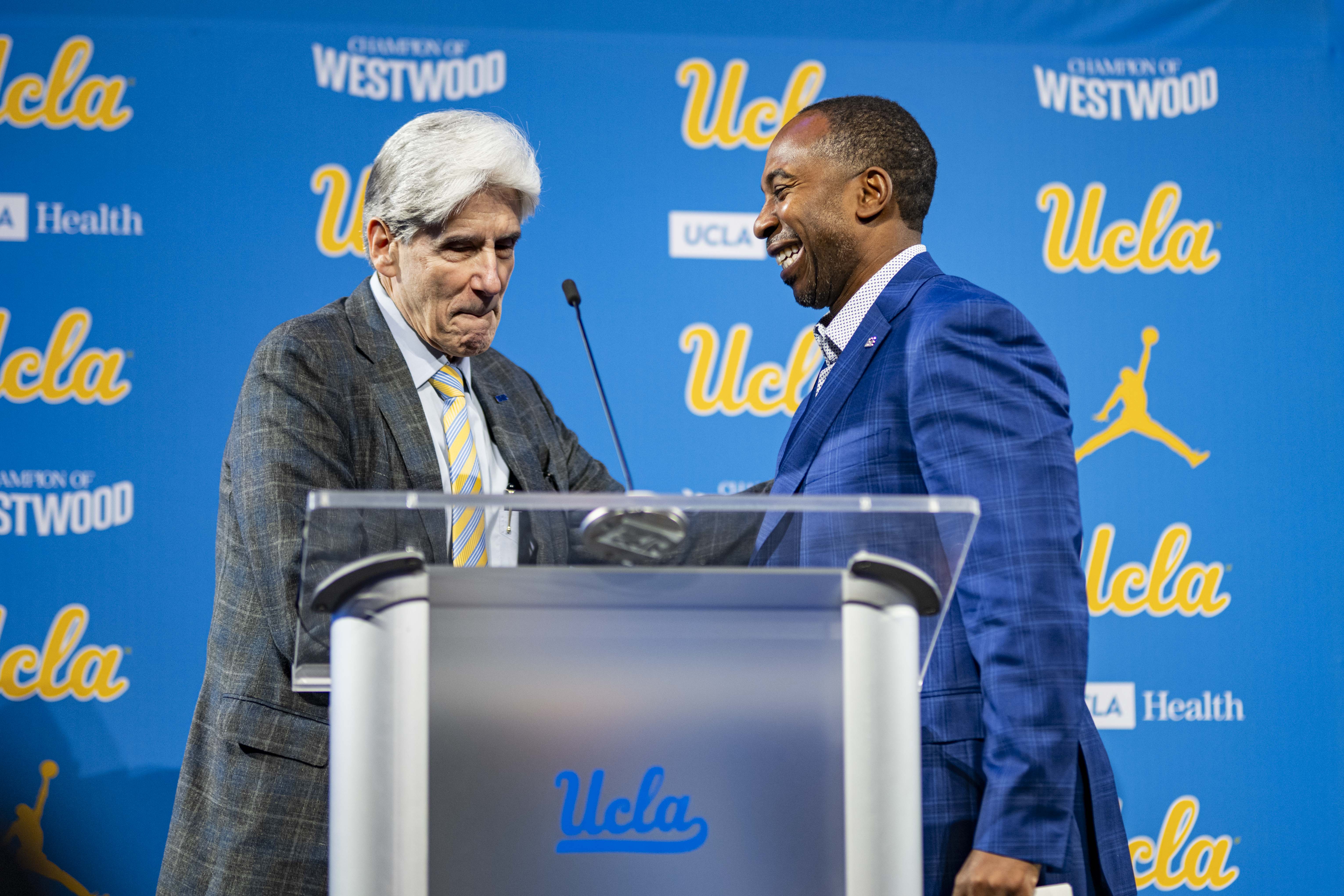
It’s important to note that Jarmond was hired under former chancellor Gene Block. Simply put, Frenk had no allegiance to the former director, and his likely frustration with Jarmond’s poor financial activity was expressed in his statement, referring to the status quo as “not sustainable.”
In the most recent fiscal cycle, the university paid $31.1 million to override UCLA Athletics’ otherwise looming debt – costs that would have amounted to more than $170 million otherwise.
It’d be remiss of me not to give Jarmond credit where credit is due. One of the most monumental moments in the school’s sporting history happened a little over two years ago when UCLA formally transferred from the Pac-12 to the Big Ten.
[Related: UC Board of Regents votes to allow UCLA’s move to Big Ten]
And while Jarmond’s oversight helped usher the Bruins into a new era with heightened media and television opportunities – with revenue from media rights payouts and the NCAA jumping 88% from 2023 to 2025 – it ultimately wasn’t enough to offset his shortcomings.
Where UCLA saw notable increases in money flowing in, it endured drop-offs everywhere else. For example, sponsorship, advertising and licensing revenue have fallen by 42% since 2023.
Jarmond’s inability to keep the program above water, even barely, understandably left a sour taste in some of UCLA’s biggest supporters’ mouths.
When donors begin to pull out of a school, that’s one of the biggest signs of a faulty brand.
In 2022, UCLA Athletics saw $18.5 million in total donations. That metric dropped by almost $3 million the next year, almost another $2 million the following year, before reaching a low of $13.5 million in 2025 – an overall 14% decline from three years ago.
Don’t get me wrong, there are Division I schools out there that would kill to get that much money over five years. But for a name as prolific as UCLA – with the history and alumni that have come through Westwood’s campus – it’s far from a great look to rank 14th out of 16 Big Ten public schools in donations.
Jarmond’s waning support and mishandling of program funds had been brewing long before the conference realignment, and Frenk’s decision to pull the plug may have come at the pinnacle of those grievances.
From the Big Ten to navigating the new NIL era to handling the COVID-19 pandemic and a shortened athletic season, Jarmond’s UCLA tenure was evidently tumultuous for reasons beyond his control.
I’m sure he tried his best.
But sometimes that isn’t enough. College sports are a business at the end of the day. And there have been several reasons that paint a murky image over the Jarmond name.
In September 2023, an email with an itinerary was sent out to a group of donors planning on traveling to a UCLA-Utah football game. Attached to that message was a leaked database that revealed the personal information and spending details of several big-name donors.
When the response on the program’s part was nothing more than a recall, void of any explicit apology, that was deemed by many as the straw that broke the camel’s back – with many donors soon going public with their disdain following the aftermath.
And while that may have been the pinnacle, the Jarmond fumbles don’t stop there.
In December 2021, UCLA football abruptly pulled out of its scheduled Holiday Bowl game against North Carolina State just hours before kickoff, citing health concerns due to COVID-19. NC State coach Dave Doeren didn’t receive the news very well, saying the team “felt lied to.”
The situation went so far as to reach a lawsuit, in which the San Diego Bowl Game Association – the Holiday Bowl’s parent company – filed a lawsuit seeking a minimum payment of $3 million from the Pac-12 and the UC Regents for damages regarding the exit.
[Related: Holiday Bowl sues Pac-12 and UC Regents over UCLA football’s 2021 exit]
Just one month after, former UCLA gymnasts made public statements expressing their displeasure with the program following UCLA Athletics’ inaction in responding to complaints about a hostile and racist environment, stemming from misconduct by then-teammate Alexis Jeffrey – who would eventually depart for LSU.
Former gymnast Margzetta Frazier said the team requested to meet with administration but was met with no response for months, eventually also calling for former head coach Chris Waller to be fired.
[Related: UCLA gymnast Margzetta Frazier calls for coaching change amid hostile environment]
Jarmond’s six years were littered with their fair share of controversy, and, to be honest, any one of these stories on their own could lead one to reasonably feel the need to fire the one at the top. Yet, he remained.
More recently, Jarmond had been consistently criticized for his lack of urgency regarding NIL, with detractors saying he was slow to embrace it and didn’t fully understand how to use it.
Others were also displeased by Jarmond’s delayed acknowledgement of contributions by Men of Westwood – a specific branch under UCLA’s overall NIL collective, Champion of Westwood.
If you looked up Jarmond’s old – now inactive – staff biography page on UCLA Athletics’ website, you’d see a few accolades listed, from various conference titles to the three current national championships the Bruins boast.
But for smaller sports like men’s water polo or beach volleyball, is it really Jarmond’s success to claim?
Using every single one of UCLA’s trophies as a reason to support Jarmond staying on board would’ve been like thanking your high school principal for getting you into college, and not your teachers or tutors.
So when you look at football – the program Jarmond left the biggest fingerprint on – you end up seeing where the results fall short of a school that has 127 all-time national championships as well as a football team that won seven straight bowl games in the 1980s.
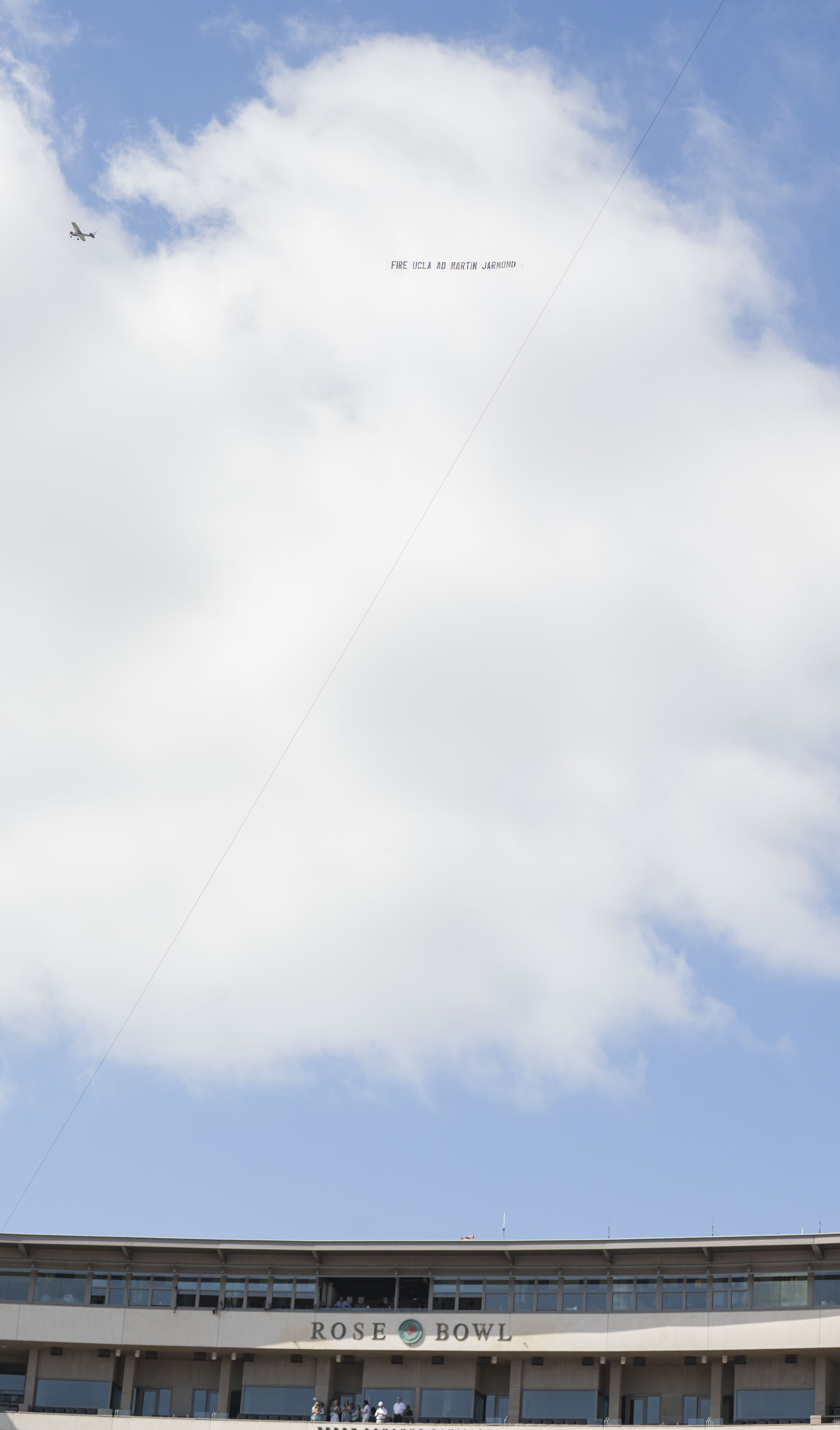
It feels like just yesterday planes were flying overhead at the Rose Bowl with banners calling to fire Jarmond.
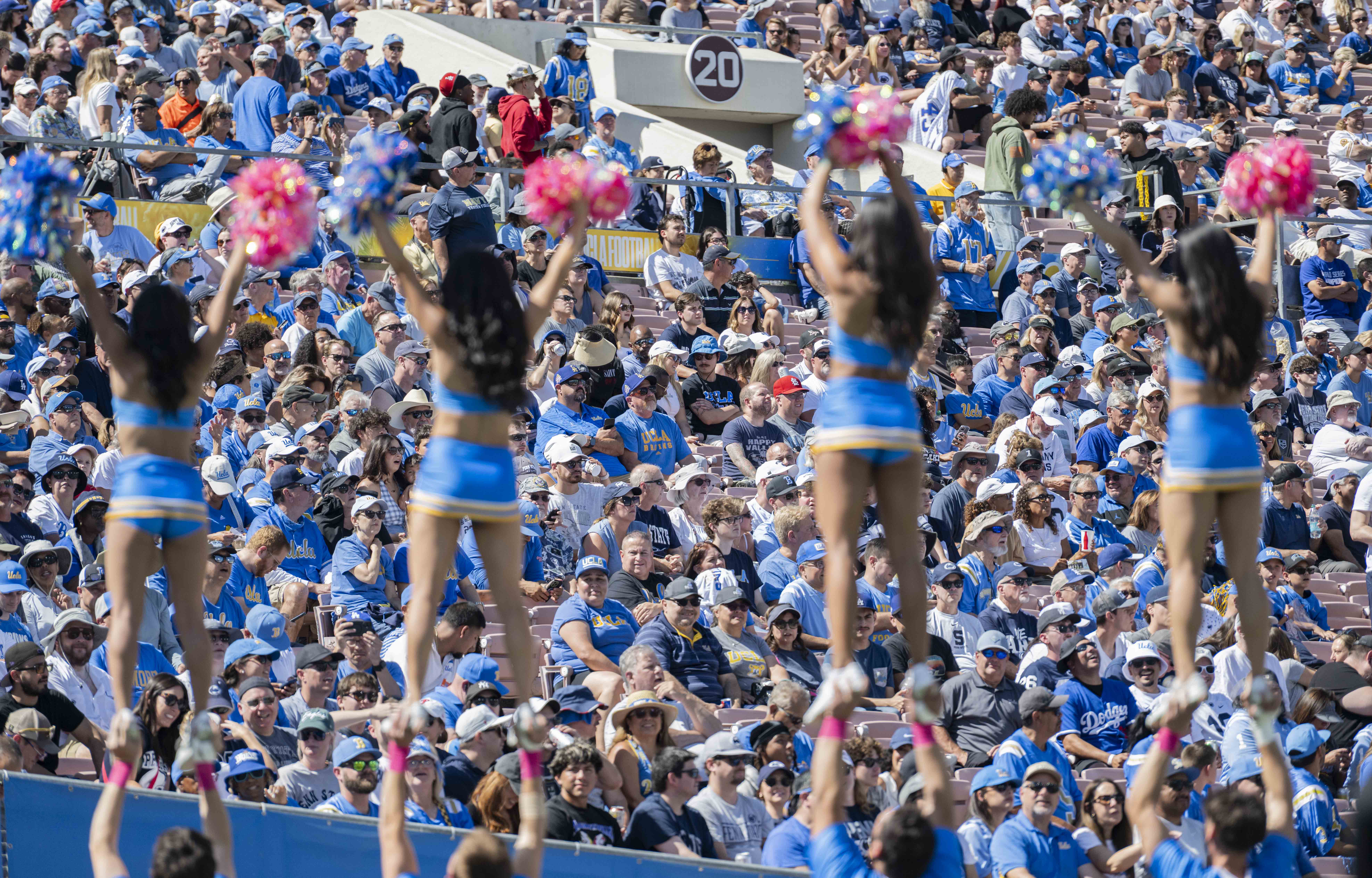
Any current UCLA student can probably tell you that the last few seasons have been underwhelming to watch the Bruins. From ticket sales that dropped by 9% from 2023-25 to entire sections of the stadium being covered to a 3-9 campaign last year, the promised allure of the Big Ten seems hardly materialized.
Many voiced their criticism of Jarmond’s refusal to get rid of former head coach Chip Kelly and his mediocrity, before he eventually resigned on his own in 2024. Then, when the Bruins hired DeShaun Foster, you scratch your head and wonder how anyone could be surprised to go 5-10 over a full season and some change with a guy who never had any formal head coaching or top coordinator experience in college football.
I couldn’t tell you if Frenk had some master plan to let Jarmond hire now-head coach Bob Chesney, just to cut him loose before the 2026 season even kicked off. But, as optimistic as I’ve been all summer for the Chesney train, I don’t even think a national championship could override everything Jarmond’s done prior.
Again, principals versus teachers – even in that fantastical hypothetical, I throw my hands up for Chesney, not Jarmond.
Only a psychic could tell you right now where UCLA Athletics goes.
Tim Harris has more than 35 years with the Lakers – one of the NBA’s most storied franchises and the league’s third-most valuable organization – to his name. His taking on the job of helping temporarily spearhead the program for free probably speaks volumes about both his faith in his alma mater to get back on track and his willingness to do what’s best for the school’s future.
Nobody knows where UCLA Athletics is going next – but for many supporters, for now, they’re breathing a sigh of relief.